



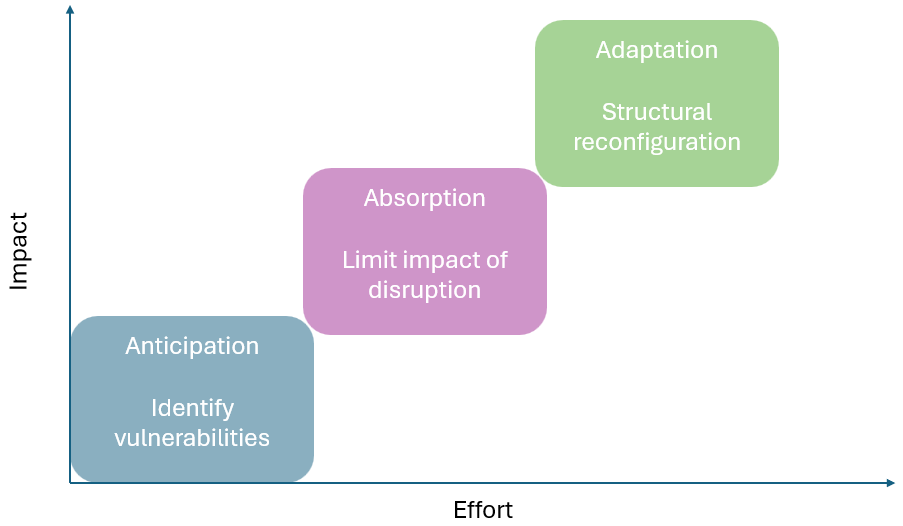
In previous blogs, we introduced a systematic framework for supply chain resilience built around three phases: anticipation, aborption and adaptation. Anticipation focuses on identifying vulnerabilities before a disruption strikes. Absorption is about making the best possible decisions while one is unfolding. In this final blog, we turn to adaptation: making lasting changes to the supply chain in response to a disruption, or in anticipation of one that may recur. As illustrated in the graphic, adaptation has the highest impact but also requires the most effort.
Beyond the temporary fix
Absorption is, by nature, a temporary fix. It minimises the impact of a disruption using whatever options are available in the moment, but it does not change the underlying structure of the supply chain. Adaptation is different, and it becomes relevant in two situations. The first is when a disruption last longer than the absorption measures can sustain. The second is when a disruption has passed but the same vulnerability remains, raising the question of what would need to change so that the next time a similar disruption has a smaller impact.
In our previous blogs, we introduced a manufacturer that sources a critical ingredient from a single supplier in Asia. In the absorption phase, the manufacturer managed the first weeks of the supplier disruption by rationing stock and substituting ingredients where possible. But if the disruption extends beyond what those measures can cover, or if that same supplier becomes unavailable again in the future, the same constraints will resurface. Adaptation asks a different question: what would need to change so that the supply chain can continue to function?
The answers can vary widely in scope, cost and complexity. Retraining personnel so they can operate across different parts of the production process increases internal flexibility. Adjusting the production process to permanently accommodate an alternative ingredient removes dependence on a single input. Establishing a new shipping route reduces exposure to a specific logistics bottleneck. These measures share a common trait: they require more investment than absorption decisions, but their effects are also far more lasting.
Acting before the next disruption
One of the most powerful aspects of adaptation is that it does not have to wait for a disruption to occur. If the anticipation phase has identified a scenario in which even the best absorption strategy is insufficient, then an adaptation measure may be needed right now, before any disruption has taken place.
Consider our manufacturer, whose safety stock can sustain operations for six weeks, but whose service level agreements require delivery for twelve weeks. The gap between the two means that absorption alone cannot handle the disruption. A structural change, such as expanding warehouse capacity to hold twelve weeks of stock, may be necessary.
A mathematical model can support this decision by comparing two quantities: the cost of implementing the adaptation measure today, and the expected cost of disruptions over time if no action is taken. If the latter outweighs the former, the case for acting now is clear. This framing also makes the decision explicit and defensible, rather than leaving it to intuition or to the urgency of the most recent disruption.
When can you afford to wait?
Not every adaptation measure needs to be implemented immediately, and this raises a practical question: when can an organisation afford to wait and see whether a disruption occurs before committing to the investment? The answer depends on two quantities: the time it takes to implement the adaptation measure, and the time the supply chain can continue to function under a disruption without it. If the supply chain can survive for longer than the measure takes to implement, waiting is a viable strategy.
In our running example, if the manufacturer can keep operating for six weeks on available stock and alternative ingredients, and the adaptation measure takes four weeks to put in place, then it is reasonable to wait and trigger the measure only if the disruption actually occurs. If, on the other hand, the supply chain can only survive for three weeks, the measure needs to be in place before any disruption hits. A mathematical model can quantify both timelines, making the decision about when to act both explicit and well-grounded.
Completing the cycle
Anticipation, absorption, and adaptation are not three separate strategies but three phases of a single, continuous approach to resilience. Anticipation maps the vulnerabilities. Absorption limits the damage when they are exposed. Adaptation ensures the supply chain emerges stronger. At each phase, mathematical models can play a crucial role. In the anticipation phase, they systematically evaluate disruption scenarios and surface vulnerabilities that are not always visible to the naked eye. In the absorption phase, they identify the best operational response under pressure, making trade-offs between service levels, inventory costs, and lost sales explicit rather than leaving them to intuition. In the adaptation phase, they compare the cost of structural investments against the long-term cost of inaction and quantify the timelines that determine whether a measure needs to be in place today or can safely wait.
Taken together, mathematical models give organisations something that is difficult to achieve otherwise: a structured, quantified basis for decision-making across the full arc of a disruption, from the first warning signs to a robust plan for future disruptions.