


Electric vehicles, heat pumps, electrified industry and a rapidly growing number of data centres are adding new demand to the power system, while generation is shifting from controllable power plants to variable solar and wind. As a result, electricity is increasingly not produced when and where it is needed: solar output peaks at midday, while demand often peaks in the evening, and new loads tend to concentrate in the same places and at the same hours. In many regions, these peaks are pushing the grid to its limits, and grid reinforcement to increase capacity can take years. Because flexibility can help address these challenges, it is now widely recognised as a key solution, and the discussion in Europe is increasingly focused on how to integrate it into the power system.
But what exactly is flexibility? In simple terms, it is the ability to adjust electricity generation or consumption in response to grid or market signals. The European Union Agency for the Cooperation of Energy Regulators (ACER) distinguishes two types of flexibility needs: system flexibility, to balance the variability of generation and demand, and network flexibility, to prevent or resolve local grid problems such as congestion and voltage issues. Traditionally, both needs have mainly been met by fossil-fuel power plants, which can increase or decrease their generation when required. As these plants are gradually replaced, flexibility needs will have to be met by non-fossil resources. For instance, batteries that store electricity and release it later, consumers who shift or reduce their demand, and solar and wind installations that can be curtailed when the grid is overloaded. Since many of these resources are connected to the distribution grid, network flexibility is becoming especially important for Distribution System Operators (DSOs), who rely on it to keep their networks reliable and cost-effective.
Who can provide flexibility?
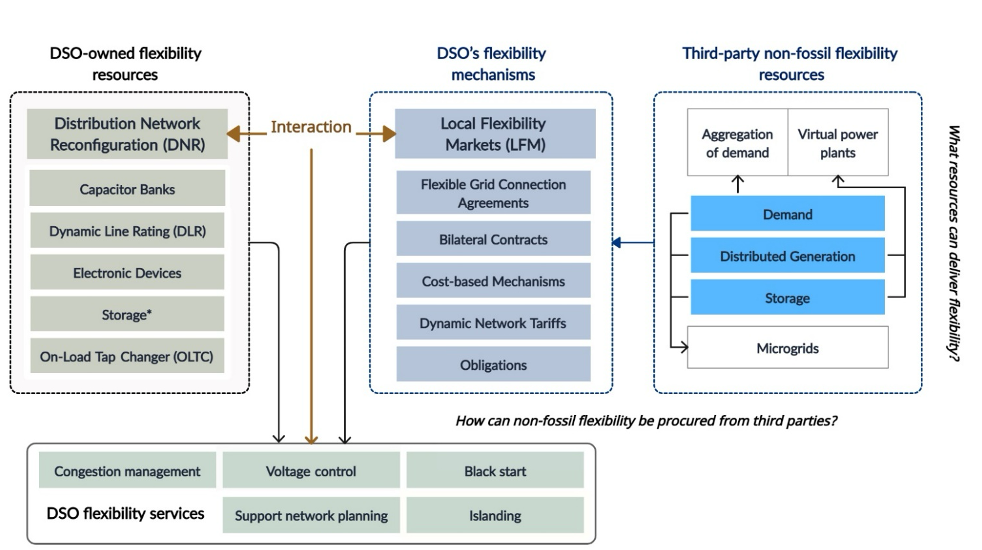
DSO-owned flexibility resources: DSOs can use their own network assets more flexibly. Reconfiguring the network redistributes power flows to relieve congested lines, while dynamic line rating allows lines to carry more power when weather conditions permit. Adjusting transformer tap settings and controlling capacitor banks help keep voltages within limits.
Third-party flexibility resources: flexibility can also be provided by resources connected to the grid that are not owned by the DSO, such as flexible consumers, local generation and batteries. These resources can be combined by aggregators or virtual power plants to offer larger volumes of flexibility.
DSOs can access this third-party flexibility through two types of mechanisms. Implicit mechanisms, such as dynamic network tariffs, use price signals that vary over time to encourage grid users to adapt their consumption or generation. However, users are not committed to respond. Explicit mechanisms, on the other hand, involve a clear commitment to deliver flexibility when the DSO needs it. Examples are, local flexibility markets, where providers in a specific grid area compete to offer flexibility; flexible grid connections, where users accept a connection capacity that can be limited at certain times; bilateral contracts negotiated between the DSO and a provider; and obligations set by regulation.
The figure below brings these elements together. Both DSO-owned and third-party resources can support a wide range of DSO services: congestion management, voltage control, black start, and islanding. Beyond daily operation, flexibility could also support network planning, as an alternative or complement to grid investments.
The real challenge: Integrating Flexibility
Using flexibility effectively is not a single decision. It involves many actors (system operators, market operators, aggregators and asset owners), many types of resources, and decisions on different time scales, from long-term grid planning to real-time operation. This makes flexibility integration a complex coordination problem, and exactly the kind of problem where mathematical optimisation creates value.
At Doing The Math, we develop optimisation models that help both system operators and flexibility providers integrate flexibility into the operation and planning of current and future power systems. For example, our models can support:
- Combining flexibility resources: finding the optimal mix of DSO-owned and third-party flexibility to meet the DSO’s specific needs.
- Flexibility procurement: deciding how much third-party flexibility to procure, from whom, where and when, at the lowest cost.
- Network planning with flexibility: finding the right balance between investing in grid expansion and using flexibility, helping to defer costly investments.
- Flexibility provision: helping aggregators and asset owners decide when and how to offer their flexibility, to maximise its value across different markets and services.
- Market design: developing algorithms for local flexibility markets, and their coordination with existing electricity markets, from day-ahead to real-time.
What is next?
In this first post, we introduced the basics of flexibility in power systems. In the next post, we will zoom in on one of the most important uses of flexibility: congestion management.
To learn more about our work on flexibility in power systems, don’t hesitate to contact us at info@doingthemath.nl.
References
ACER (2025). Decision No 05/2025, Annex I: Type and format of data and the methodology for TSOs’ and DSOs’ flexibility needs analysis. https://www.acer.europa.eu/sites/default/files/documents/
Individual%20Decisions_annex/ACER-Decision-05-2025-FNAM-Annex-I.pdf
Valarezo, O., Chaves-Ávila, J.P. & Gómez, T. (2023). Exploring the Interaction Between Electricity Distribution Network Reconfiguration and Local Flexibility Markets. Current Sustainable/Renewable Energy Reports, 10, 170–182. https://doi.org/10.1007/s40518-023-00221-6